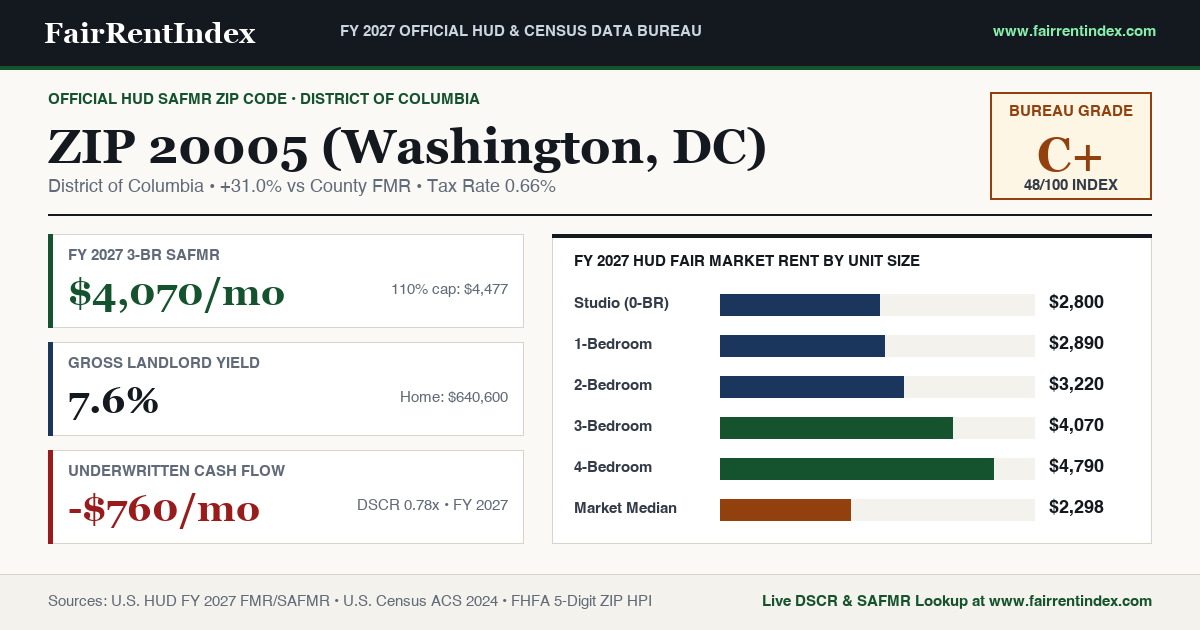
ZIP 20005 (Washington, DC) Prioritizes Long-Term Equity Over Day-One Cash Flow
At a median owner-occupied home value of $640,600, acquiring a standard 3-bedroom single-family rental in ZIP 20005 (Washington, DC) at 20% down produces compressed initial yields (7.6% gross). Investors active in ZIP 20005 (Washington, DC) generally focus on Small Area FMR high-opportunity pockets, multi-unit small plexes, or ADU additions rather than expecting single-family 1% Rule cash flow on day one.
FY 2027 HUD Fair Market Rent Benchmark & Relative Positioning
For Fiscal Year 2027 (effective October 1, 2026), the U.S. Department of Housing and Urban Development establishes a 2-bedroom Fair Market Rent of $3,220/month and a 3-bedroom Fair Market Rent of $4,070/month in ZIP 20005 (Washington, DC). On a 3-bedroom basis, this positions ZIP 20005 (Washington, DC) +31.0% compared to the District of Columbia population-weighted average ($3,107/mo) and +79.5% relative to the U.S. national benchmark ($2,268/mo).
Under federal regulation (24 CFR § 982.503), Public Housing Agencies operate within a basic range of 90% to 110% of HUD's published FMR without requiring special federal waivers. In ZIP 20005 (Washington, DC), that translates into an authorized 2-bedroom payment standard corridor of $2,898 to $3,542/month and a 3-bedroom corridor of $3,663 to $4,477/month. Where PHAs elect the 110% upper band—or secure a 120% exception standard ($4,884/mo for 3-BR)—well-renovated single-family homes can command strong monthly gross receipts. Remember that HUD's FMR includes both contract rent and tenant-paid utility allowances; if the tenant pays gas, electricity, and water separately, the PHA deducts the local utility allowance schedule from the maximum gross cap.
How ZIP 20005 Compares Against District of Columbia & Neighboring Corridors
Under HUD's Small Area Fair Market Rent methodology, ZIP code 20005 carries a FY 2027 3-bedroom benchmark of $4,070/month, sitting +31.0% relative to the overall District of Columbia county FMR ($3,107/month). Because local Public Housing Authorities may set payment standards anywhere between 90% ($3,663) and 110% ($4,477) of the published SAFMR—and up to 120% ($4,884) with HUD exception approval—actual achievable voucher rent in 20005 depends heavily on property condition and bedroom count.
Landlord Cash-Flow Underwriting, Taxes & Housing Stock Reality
Using verified U.S. Census ACS 5-Year housing and property tax filings, owner-occupied residences in ZIP 20005 (Washington, DC) carry a median valuation of $640,600 and an effective property tax rate of 0.66% (roughly $4,228/year on a median-priced home). Plugging those local inputs into a conservative 3-bedroom buy-and-hold underwriting model (20% down payment, 7.25% 30-year fixed investor loan, $1,520/yr District of Columbia benchmark landlord insurance, 8% maintenance, 5% vacancy, and 8% professional management) yields an estimated monthly net cash flow of -$760/month and a Debt Service Coverage Ratio (DSCR) of 0.78x.
According to U.S. Census ACS building-age records, the median residential structure in ZIP 20005 (Washington, DC) was constructed in 1970—prior to the 1978 federal ban on residential lead-based paint. Under HUD's updated NSPIRE (National Standards for the Physical Inspection of Real Estate) protocol, properties built before 1978 face stricter scrutiny for chipping or peeling paint (especially when children under age six reside in the home), GFCI outlet protection near water sources, and legacy plumbing or electrical panels. Factoring an extra 2%–3% into initial turnover CapEx helps landlords pass first-round PHA inspections without losing a month of HAP revenue.
With a median owner-occupied home value of $640,600 and a local renter share of 68.5%, ZIP 20005 (Washington, DC) maintains an established tenant pool. Over the past five years, local rent benchmarks shifted by +23.2%, underscoring the inflation-hedging nature of federally indexed rental housing.
District of Columbia Landlord-Tenant Laws, Eviction Timelines & Regulatory Risk
Yield numbers on paper only materialize when state statutes protect predictable lease enforcement. In our 50-state statutory index, District of Columbia earns a Grade D (22/100) landlord-friendliness rating. District of Columbia operates under statewide rent stabilization statutes, requires a standard 30-day notice for nonpayment for nonpayment, caps security deposits at 1 month rent, and averages approximately 95 days for uncontested nonpayment possession proceedings. Washington, D.C. operates strong tenant protections, TOPA sale rights, and strict rent stabilization, yet DCHA pays some of the highest Small Area FMR voucher rates in the United States.
Renter Affordability, Cost Burden & Local Housing Authority Administration
From a household affordability perspective, earning enough to pay the FY 2027 2-bedroom Fair Market Rent of $3,220/month without becoming cost-burdened (spending no more than 30% of gross income on housing) requires an annual household income of approximately $128,800—and $162,800/year for a 3-bedroom unit ($4,070/month). Comparing that threshold against ZIP 20005 (Washington, DC)'s Census median household income of $116,724 illustrates why voucher demand remains structurally resilient: across District of Columbia, 46.6% of renter households currently spend more than 30% of income on rent and utilities, including 23.6% who are severely cost-burdened (50%+ of income).
Housing Choice Vouchers in this jurisdiction are administered locally by D.C Housing Authority (HUD Code: DC001) alongside 1 additional regional housing authorities. Federal HUD eGIS records indicate D.C Housing Authority oversees approximately 16,478 assisted units operating at a 80.8% occupancy utilization rate, disbursing an average federal subsidy of roughly $1,313/month per household. Landlords wishing to lease to voucher holders must complete the agency's Request for Tenancy Approval (RFTA) packet and pass an initial NSPIRE unit inspection.