FY 2027 LIVE U.S. Avg 2-BR FMR: $1,763 U.S. Avg 3-BR FMR: $2,268 Counties: 3,145 SAFMR ZIPs: 19,769 PHAs: 3,697
Sources: HUD PD&R FY 2027 • U.S. Census ACS 2024 • FHFA HPI
FairRentIndex U.S. Fair Market Rent, Section 8 SAFMR & Landlord Yield Bureau
Voucher Premium Arbitrage Zone Mandatory SAFMR Metro HUD Area: Detroit-Warren-Livonia, MI HUD Metro FMR Area • FIPS 26163

Wayne County, Michigan Fair Market Rent & Section 8 Limits (2026–2027)

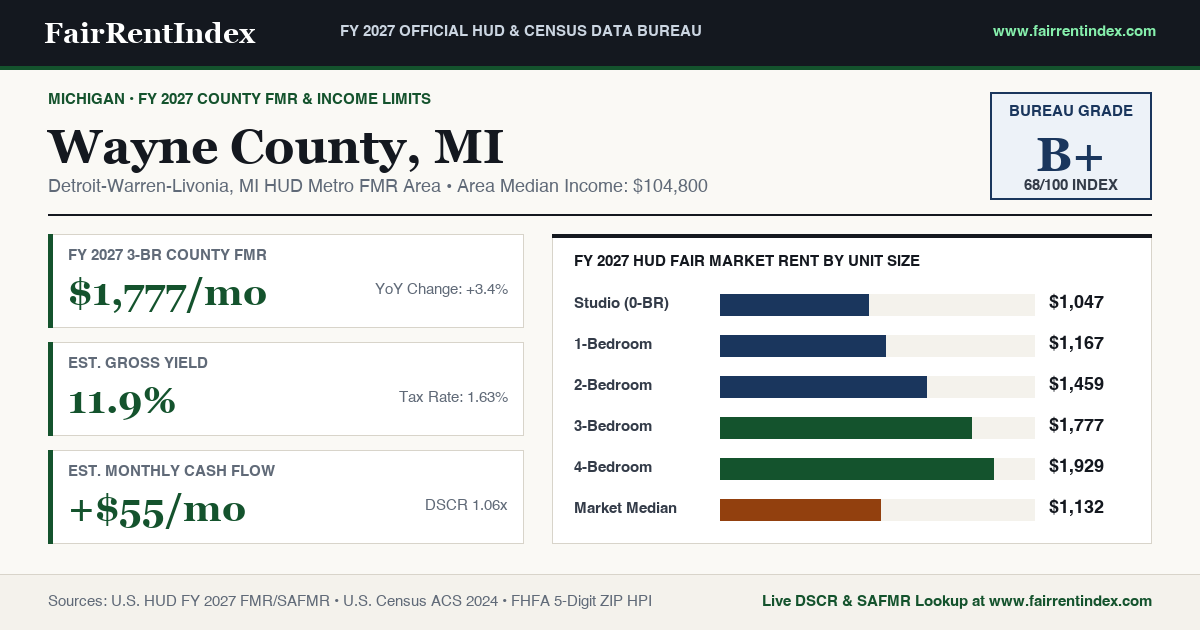
Official FY 2027 HUD Fair Market Rents in Wayne County, MI moved +3.4% from FY 2026, setting 2-bedroom FMR at $1,459/mo and 3-bedroom FMR at $1,777/mo. Census ACS data shows 54.3% of local renters spend 30%+ of income on housing.

3-BR FY 2027 FMR
$1,777
FY 2026: $1,724 (+3.4%)
Area Median Income
$104,800
Eff. Property Tax
1.63%
Median tax: $2,904/yr
Gross Rental Yield
11.9%
Grade B+ • DSCR 1.06x
2026–2027 Quick Voucher Answer • HUD FY 2027 Schedule (Effective Oct 1, 2026)

How Much Does Section 8 Pay in Wayne County, MI? (2026–2027 Voucher Amounts)

For 2026–2027, official HUD Section 8 Fair Market Rent benchmarks in Wayne County, MI are $1,047/mo (Studio), $1,167/mo (1-Bedroom), $1,459/mo (2-Bedroom), $1,777/mo (3-Bedroom), and $1,929/mo (4-Bedroom). Local housing authorities may authorize up to a 110% payment standard (up to $1,955/mo for a 3-bedroom), less any tenant utility allowance.

Run the interactive DSCR & Rent Calculator ↓ • Check 2026–2027 Income Limits (1–8 Persons) →

Federal Benchmark Schedule • 24 CFR § 982.503

Wayne County, MI 2026–2027 vs. Prior HUD Fair Market Rents

HUD sets baseline Fair Market Rents at 100%. Local Public Housing Authorities may establish payment standards anywhere from 90% to 110% automatically, or up to 120% under HUD exception waivers.

Unit Size FY 2027 FMR (100%) PHA Low (90%) PHA High (110%) Exception (120%) FY 2026YoY %
Studio (0-BR) $1,047 $942 $1,152 $1,256 $1,009+3.8%
1-Bedroom $1,167 $1,050 $1,284 $1,400 $1,122+4.0%
2-Bedroom $1,459 $1,313 $1,605 $1,751 $1,411+3.4%
3-Bedroom $1,777 $1,599 $1,955 $2,132 $1,724+3.1%
4-Bedroom $1,929 $1,736 $2,122 $2,315 $1,868+3.3%
Official FY 2026 HUD Section 8 Income Limits • AMI: $104,800

Wayne County, MI Section 8 Income Eligibility Table

Full 8-Person Table →
Income Tier1 Person2 Persons3 Persons4 Persons5 Persons6 Persons
Extremely Low 30% AMI (Priority)$23,100$26,400$29,700$33,000$35,650$38,300
Very Low 50% AMI (Standard Max)$36,700$41,900$47,150$52,400$56,600$60,800
Low Income 80% AMI (Exception)$58,700$67,100$75,500$83,850$90,600$97,300

Federal law reserves 75% of newly issued Housing Choice Vouchers for Extremely Low Income (30% AMI) households. Test your exact household eligibility →

Municipalities in Wayne County

Cities & Towns in Wayne County

ZIP-Code Breakdown in Wayne County

Wayne County Section 8 Rents by ZIP Code

ZIPCity2-BR3-BRMedian HomeYieldGrade
48217 Detroit $1,440 $1,750 $65,500 32.1% A+
48228 Detroit $1,290 $1,570 $59,500 31.7% A+
48204 Detroit $1,260 $1,540 $59,200 31.2% A+
48205 Detroit $1,360 $1,670 $65,300 30.7% A+
48213 Detroit $1,140 $1,400 $56,200 29.9% A+
48234 Detroit $1,230 $1,500 $61,200 29.4% A+
48238 Detroit $1,220 $1,490 $64,800 27.6% A+
48141 Inkster $1,480 $1,810 $80,400 27.0% A+
48229 Ecorse $1,210 $1,470 $65,400 27.0% A+
48210 Detroit $1,220 $1,490 $67,800 26.4% A+
48218 River Rouge $1,110 $1,360 $65,200 25.0% A+
48227 Detroit $1,280 $1,560 $75,100 24.9% A+
48224 Detroit $1,430 $1,740 $88,700 23.5% A+
48211 Detroit $1,230 $1,500 $78,900 22.8% A+
48235 Detroit $1,400 $1,700 $90,000 22.7% A+
48203 Detroit $1,120 $1,380 $76,200 21.7% A+
48219 Detroit $1,440 $1,750 $99,200 21.2% A+
48223 Detroit $1,290 $1,570 $99,500 18.9% A+
48209 Detroit $1,110 $1,360 $89,000 18.3% A+
48240 Detroit $1,680 $2,050 $135,300 18.2% A+
48125 Dearborn Heights $1,650 $2,020 $140,600 17.2% A+
48122 Melvindale $1,470 $1,790 $125,800 17.1% A+
48215 Detroit $1,250 $1,520 $111,000 16.4% A+
48225 Harper Woods $1,700 $2,080 $153,800 16.2% A+
48239 Detroit $1,730 $2,120 $158,800 16.0% A+
48212 Detroit $1,140 $1,400 $109,200 15.4% A
48206 Detroit $1,170 $1,430 $116,300 14.8% A+
48146 Lincoln Park $1,250 $1,520 $131,000 13.9% A
48221 Detroit $1,450 $1,770 $154,600 13.7% A
48174 Romulus $1,410 $1,720 $162,100 12.7% B+
48120 Dearborn $1,890 $2,310 $224,000 12.4% A
48180 Taylor $1,270 $1,550 $152,600 12.2% B
48128 Dearborn $2,130 $2,600 $258,700 12.1% B
48186 Westland $1,410 $1,720 $174,000 11.9% B+
48195 Southgate $1,400 $1,700 $173,600 11.8% B+
Interactive Underwriting Terminal • Pre-Loaded with Wayne County, MI Data

Section 8 Cash-Flow & DSCR Calculator for Wayne County, MI

Adjust purchase price, bedroom voucher tier, down payment, or interest rate to model real monthly net cash flow and DSCR lender qualification in real time.

Estimated Monthly Net Cash Flow
+$55/mo
DSCR: 1.06x 1% Ratio: 1.00%
Gross Rental Yield11.9%
Cap Rate (NOI / Price)6.9%
Cash-on-Cash Return1.6%
Monthly Mortgage (P&I)$974
Taxes + Insurance / mo$375
Maint / Vac / Mgmt Reserve$373
Est. Total Cash to Close (23%)$41,055
Historical Trend & Shareable County Infographic

Wayne County, MI Rent History (2019 – FY 2027)

$750$963$1,175$1,388$1,600 2019$87520202021202220232024FY26FY27$1,459
Studio (0-BR) HUD FMR $1,047 1-Bedroom HUD FMR $1,167 2-Bedroom HUD FMR $1,459 3-Bedroom HUD FMR $1,777 4-Bedroom HUD FMR $1,929 Census Private Market Median $1,132
Wayne County, MI FY 2027 HUD Fair Market Rent & Income Limits Infographic
Official FY 2027 Wayne County, MI HUD FMR & Property Tax Card Download Chart PNG
Embed Live FY 2027 Widget / Cite This Chart on Your Site (Free)

Real estate bloggers, agents, and housing nonprofits may embed this auto-updated FY 2027 HUD benchmark card free with attribution:

Market Classification: Voucher Premium Arbitrage Zone

HUD Voucher Ceilings Outpace Private Market Rents in Wayne County, MI

A defining feature of Wayne County, MI in FY 2027 is the wide spread between government-backed rents and local private-market leases. While the Census ACS median gross rent stands at $1,132/month, HUD's 2-bedroom Fair Market Rent reaches $1,459/month—a +28.9% voucher premium that allows compliant landlords to boost gross income without exceeding federal rent-reasonableness guardrails.

FY 2027 HUD Fair Market Rent Benchmark & Relative Positioning

For Fiscal Year 2027 (effective October 1, 2026), the U.S. Department of Housing and Urban Development establishes a 2-bedroom Fair Market Rent of $1,459/month and a 3-bedroom Fair Market Rent of $1,777/month in Wayne County, MI. On a 3-bedroom basis, this positions Wayne County, MI +4.7% compared to the Michigan population-weighted average ($1,697/mo) and -21.6% relative to the U.S. national benchmark ($2,268/mo).

Under federal regulation (24 CFR § 982.503), Public Housing Agencies operate within a basic range of 90% to 110% of HUD's published FMR without requiring special federal waivers. In Wayne County, MI, that translates into an authorized 2-bedroom payment standard corridor of $1,313 to $1,605/month and a 3-bedroom corridor of $1,599 to $1,955/month. Where PHAs elect the 110% upper band—or secure a 120% exception standard ($2,132/mo for 3-BR)—well-renovated single-family homes can command strong monthly gross receipts. Remember that HUD's FMR includes both contract rent and tenant-paid utility allowances; if the tenant pays gas, electricity, and water separately, the PHA deducts the local utility allowance schedule from the maximum gross cap.

Landlord Cash-Flow Underwriting, Taxes & Housing Stock Reality

Using verified U.S. Census ACS 5-Year housing and property tax filings, owner-occupied residences in Wayne County, MI carry a median valuation of $178,500 and an effective property tax rate of 1.63% (roughly $2,910/year on a median-priced home). Plugging those local inputs into a conservative 3-bedroom buy-and-hold underwriting model (20% down payment, 7.25% 30-year fixed investor loan, $1,590/yr Michigan benchmark landlord insurance, 8% maintenance, 5% vacancy, and 8% professional management) yields an estimated monthly net cash flow of +$55/month and a Debt Service Coverage Ratio (DSCR) of 1.06x.

According to U.S. Census ACS building-age records, the median residential structure in Wayne County, MI was constructed in 1956—prior to the 1978 federal ban on residential lead-based paint. Under HUD's updated NSPIRE (National Standards for the Physical Inspection of Real Estate) protocol, properties built before 1978 face stricter scrutiny for chipping or peeling paint (especially when children under age six reside in the home), GFCI outlet protection near water sources, and legacy plumbing or electrical panels. Factoring an extra 2%–3% into initial turnover CapEx helps landlords pass first-round PHA inspections without losing a month of HAP revenue.

With a median owner-occupied home value of $178,500 and a local renter share of 35.2%, Wayne County, MI maintains an established tenant pool. Over the past five years, local rent benchmarks shifted by +29.4%, underscoring the inflation-hedging nature of federally indexed rental housing.

Michigan Landlord-Tenant Laws, Eviction Timelines & Regulatory Risk

Yield numbers on paper only materialize when state statutes protect predictable lease enforcement. In our 50-state statutory index, Michigan earns a Grade B+ (74/100) landlord-friendliness rating. Michigan operates under a statewide preemption banning local rent control, requires a standard 7-day pay or quit for nonpayment, caps security deposits at 1.5 months rent, and averages approximately 34 days for uncontested nonpayment possession proceedings. Michigan prohibits local rent control statewide and boasts some of the highest Section 8 gross rental yields in America across Detroit, Flint, Saginaw, and Grand Rapids.

Renter Affordability, Cost Burden & Local Housing Authority Administration

From a household affordability perspective, earning enough to pay the FY 2027 2-bedroom Fair Market Rent of $1,459/month without becoming cost-burdened (spending no more than 30% of gross income on housing) requires an annual household income of approximately $58,360—and $71,080/year for a 3-bedroom unit ($1,777/month). Comparing that threshold against Wayne County, MI's Census median household income of $60,539 illustrates why voucher demand remains structurally resilient: across Wayne County, 54.3% of renter households currently spend more than 30% of income on rent and utilities, including 30.9% who are severely cost-burdened (50%+ of income).

Housing Choice Vouchers in this jurisdiction are administered locally by Detroit Housing Commission (HUD Code: MI001) alongside 11 additional regional housing authorities. Federal HUD eGIS records indicate Detroit Housing Commission oversees approximately 6,590 assisted units operating at a 72.2% occupancy utilization rate, disbursing an average federal subsidy of roughly $941/month per household. Landlords wishing to lease to voucher holders must complete the agency's Request for Tenancy Approval (RFTA) packet and pass an initial NSPIRE unit inspection.

Verified Landlord & Housing Resource • Sponsored Partner
Steadily Landlord Insurance

Fast digital coverage built specifically for Section 8 & buy-and-hold rental properties.

Get Instant Landlord Insurance Quote →
Verified Regulatory & Market Answers

Wayne County, MI Fair Market Rent FAQ

How much does Section 8 pay for a 1, 2, 3, or 4 bedroom in Wayne County, MI (2026–2027)?
Under HUD's FY 2027 Fair Market Rent schedule (effective October 1, 2026 through September 30, 2027), baseline voucher benchmarks in Wayne County, MI are $1,047/mo for a Studio (0-BR), $1,167/mo for a 1-Bedroom, $1,459/mo for a 2-Bedroom, $1,777/mo for a 3-Bedroom, and $1,929/mo for a 4-Bedroom. At a 110% PHA payment standard, caps reach $1,605/mo (2-BR) and $1,955/mo (3-BR), minus any tenant-paid utility allowance.
What is the maximum Section 8 voucher amount in Wayne County, MI for 2026–2027?
Local housing authorities can set 2026–2027 Section 8 payment standards between 90% ($1,599/mo) and 110% ($1,955/mo) of HUD FMR for a 3-bedroom—or up to 120% ($2,132/mo) with HUD exception approval. Final approved rent also depends on unit bedroom count, utility allowances, and local rent reasonableness.
What is the Section 8 income limit for a family of 4 in Wayne County, MI (2026–2027)?
For Wayne County, HUD's 4-person Very Low Income limit (50% AMI, standard qualification ceiling) is $52,400/year, while the priority Extremely Low Income limit (30% AMI, reserved for 75% of new vouchers) is $33,000/year. A single-person (1-person) household qualifies at $36,700/year (50% AMI) or $23,100/year (30% AMI).
Is Wayne County, MI a good market for Section 8 real estate investing?
Wayne County, MI earns an overall Investment Grade of B+ (68/100) under our 2026–2027 model, with a 11.9% estimated gross rental yield, a +28.9% HUD-vs-market rent spread, an effective property tax rate of 1.63%, and Michigan's Grade B+ landlord-tenant legal rating.
Does Wayne County, MI meet the 1% Rule for rental properties?
Based on a median home value of $178,500 and a 3-bedroom HUD FMR of $1,777/month, Wayne County, MI posts a monthly rent-to-price ratio of 1.00%—meaning it currently sits below the classic 1.00% Rule at median pricing.
How much income do you need to afford rent in Wayne County, MI without a voucher?
Following the 30% gross income standard, comfortably affording the 2026–2027 2-bedroom HUD benchmark ($1,459/mo) requires roughly $58,360/year in household income, while a 3-bedroom ($1,777/mo) requires $71,080/year—compared to the local Census median household income of $60,539.
Does Wayne County, MI use ZIP-code Small Area Fair Market Rents (SAFMR)?
Yes. Wayne County, MI falls within a Small Area Fair Market Rent (SAFMR) area, meaning payment standards are calculated at the individual 5-digit ZIP code level rather than a flat metropolitan average—creating higher ceilings in lower-poverty neighborhoods.
Community Intelligence • Moderated Before Publishing

Local Landlord & Renter Field Notes: Wayne County, MI

No verified local field notes published for Wayne County, MI yet. Share your real NSPIRE inspection timeline, PHA responsiveness, or waitlist experience below.

Submit a Local PHA, Inspection, or Cash-Flow Field Note