Orangeville, UT Delivers Balanced Fundamentals for Long-Term Rental Portfolios
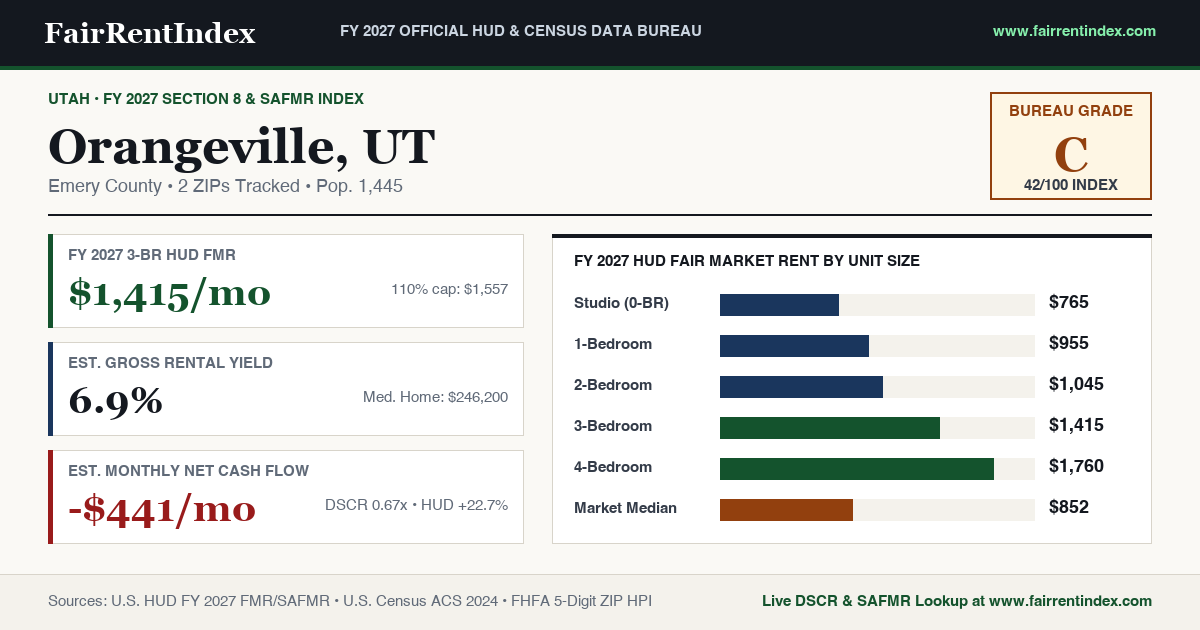
Orangeville, UT exhibits steady, middle-of-the-fairway housing economics: a FY 2027 3-bedroom HUD Fair Market Rent of $1,415/month against a $246,200 median home value (6.9% gross yield) and a 0.58% effective property tax burden. Combined with Utah's Grade A- landlord-tenant legal framework, this area rewards disciplined buy-and-hold underwriting.
FY 2027 HUD Fair Market Rent Benchmark & Relative Positioning
For Fiscal Year 2027 (effective October 1, 2026), the U.S. Department of Housing and Urban Development establishes a 2-bedroom Fair Market Rent of $1,045/month and a 3-bedroom Fair Market Rent of $1,415/month in Orangeville, UT. On a 3-bedroom basis, this positions Orangeville, UT -29.4% compared to the Utah population-weighted average ($2,004/mo) and -37.6% relative to the U.S. national benchmark ($2,268/mo).
Under federal regulation (24 CFR § 982.503), Public Housing Agencies operate within a basic range of 90% to 110% of HUD's published FMR without requiring special federal waivers. In Orangeville, UT, that translates into an authorized 2-bedroom payment standard corridor of $941 to $1,150/month and a 3-bedroom corridor of $1,274 to $1,557/month. Where PHAs elect the 110% upper band—or secure a 120% exception standard ($1,698/mo for 3-BR)—well-renovated single-family homes can command strong monthly gross receipts. Remember that HUD's FMR includes both contract rent and tenant-paid utility allowances; if the tenant pays gas, electricity, and water separately, the PHA deducts the local utility allowance schedule from the maximum gross cap.
Landlord Cash-Flow Underwriting, Taxes & Housing Stock Reality
Using verified U.S. Census ACS 5-Year housing and property tax filings, owner-occupied residences in Orangeville, UT carry a median valuation of $246,200 and an effective property tax rate of 0.58% (roughly $1,428/year on a median-priced home). Plugging those local inputs into a conservative 3-bedroom buy-and-hold underwriting model (20% down payment, 7.25% 30-year fixed investor loan, $1,150/yr Utah benchmark landlord insurance, 8% maintenance, 5% vacancy, and 8% professional management) yields an estimated monthly net cash flow of -$441/month and a Debt Service Coverage Ratio (DSCR) of 0.67x.
According to U.S. Census ACS building-age records, the median residential structure in Orangeville, UT was constructed in 1977—prior to the 1978 federal ban on residential lead-based paint. Under HUD's updated NSPIRE (National Standards for the Physical Inspection of Real Estate) protocol, properties built before 1978 face stricter scrutiny for chipping or peeling paint (especially when children under age six reside in the home), GFCI outlet protection near water sources, and legacy plumbing or electrical panels. Factoring an extra 2%–3% into initial turnover CapEx helps landlords pass first-round PHA inspections without losing a month of HAP revenue.
With a median owner-occupied home value of $246,200 and a local renter share of 11.0%, Orangeville, UT maintains an established tenant pool. Over the past five years, local rent benchmarks shifted by +22.1%, underscoring the inflation-hedging nature of federally indexed rental housing.
Utah Landlord-Tenant Laws, Eviction Timelines & Regulatory Risk
Yield numbers on paper only materialize when state statutes protect predictable lease enforcement. In our 50-state statutory index, Utah earns a Grade A- (81/100) landlord-friendliness rating. Utah operates under a statewide preemption banning local rent control, requires a standard 3-day pay or quit for nonpayment, caps security deposits at No statutory limit, and averages approximately 24 days for uncontested nonpayment possession proceedings. Utah bans rent control, enforces rapid 3-day notices, and enjoys low property taxes and insurance costs, though high Wasatch Front home prices limit gross yield.
Renter Affordability, Cost Burden & Local Housing Authority Administration
From a household affordability perspective, earning enough to pay the FY 2027 2-bedroom Fair Market Rent of $1,045/month without becoming cost-burdened (spending no more than 30% of gross income on housing) requires an annual household income of approximately $41,800—and $56,600/year for a 3-bedroom unit ($1,415/month). Comparing that threshold against Orangeville, UT's Census median household income of $90,086 illustrates why voucher demand remains structurally resilient: across Emery County, 44.5% of renter households currently spend more than 30% of income on rent and utilities, including 23.9% who are severely cost-burdened (50%+ of income).
Housing Choice Vouchers in this jurisdiction are administered locally by Emery County Housing Authority (HUD Code: UT015). Federal HUD eGIS records indicate Emery County Housing Authority oversees approximately 0 assisted units. Landlords wishing to lease to voucher holders must complete the agency's Request for Tenancy Approval (RFTA) packet and pass an initial NSPIRE unit inspection.