Greenfield, MN Prioritizes Long-Term Equity Over Day-One Cash Flow
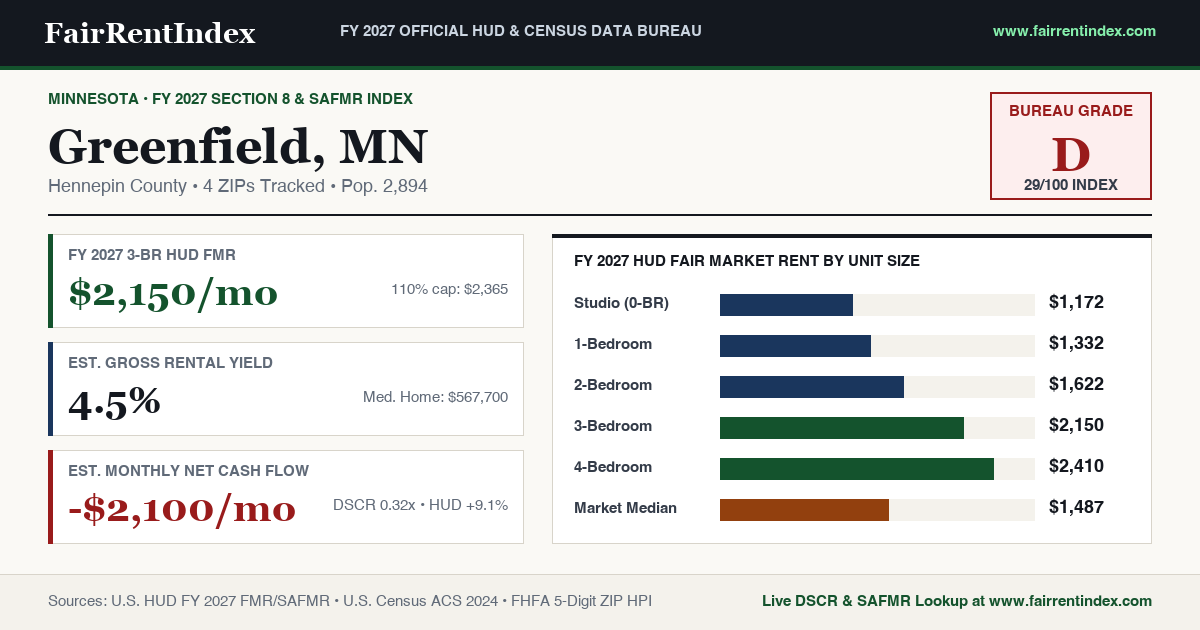
At a median owner-occupied home value of $567,700, acquiring a standard 3-bedroom single-family rental in Greenfield, MN at 20% down produces compressed initial yields (4.5% gross). Investors active in Greenfield, MN generally focus on Small Area FMR high-opportunity pockets, multi-unit small plexes, or ADU additions rather than expecting single-family 1% Rule cash flow on day one.
FY 2027 HUD Fair Market Rent Benchmark & Relative Positioning
For Fiscal Year 2027 (effective October 1, 2026), the U.S. Department of Housing and Urban Development establishes a 2-bedroom Fair Market Rent of $1,622/month and a 3-bedroom Fair Market Rent of $2,150/month in Greenfield, MN. On a 3-bedroom basis, this positions Greenfield, MN +8.6% compared to the Minnesota population-weighted average ($1,980/mo) and -5.2% relative to the U.S. national benchmark ($2,268/mo).
Under federal regulation (24 CFR § 982.503), Public Housing Agencies operate within a basic range of 90% to 110% of HUD's published FMR without requiring special federal waivers. In Greenfield, MN, that translates into an authorized 2-bedroom payment standard corridor of $1,460 to $1,784/month and a 3-bedroom corridor of $1,935 to $2,365/month. Where PHAs elect the 110% upper band—or secure a 120% exception standard ($2,580/mo for 3-BR)—well-renovated single-family homes can command strong monthly gross receipts. Remember that HUD's FMR includes both contract rent and tenant-paid utility allowances; if the tenant pays gas, electricity, and water separately, the PHA deducts the local utility allowance schedule from the maximum gross cap.
ZIP-Code Spread Inside Greenfield, MN: Why City Averages Mislead Investors
Evaluating Greenfield, MN using a single city-wide average hides significant neighborhood-level variance across its 2 tracked ZIP codes. For a 3-bedroom voucher in FY 2027, HUD Small Area FMR caps range from $2,150/month in ZIP 55373 all the way up to $2,150/month in ZIP 55373—a $0/month spread within the exact same municipal market.
On a yield-adjusted basis, ZIP 55373 leads Greenfield, MN with an estimated 7.1% gross yield ($2,150/mo 3-BR limit vs. $363,900 median home value), whereas lower-yielding ZIPs such as 55357 (4.9% gross yield) lean heavily toward equity preservation. Experienced Section 8 buyers filter directly by ZIP code using the sortable matrix above before submitting offers.
Landlord Cash-Flow Underwriting, Taxes & Housing Stock Reality
Using verified U.S. Census ACS 5-Year housing and property tax filings, owner-occupied residences in Greenfield, MN carry a median valuation of $567,700 and an effective property tax rate of 1.16% (roughly $6,585/year on a median-priced home). Plugging those local inputs into a conservative 3-bedroom buy-and-hold underwriting model (20% down payment, 7.25% 30-year fixed investor loan, $1,820/yr Minnesota benchmark landlord insurance, 8% maintenance, 5% vacancy, and 8% professional management) yields an estimated monthly net cash flow of -$2,100/month and a Debt Service Coverage Ratio (DSCR) of 0.32x.
U.S. Census housing stock records place the median residential build year in Greenfield, MN at 1994, indicating predominantly post-1978 construction. Newer housing inventory typically reduces pre-1978 lead-based paint remediation risks and improves first-time pass rates under HUD's NSPIRE inspection framework—though inspectors still strictly enforce hard-wired or 10-year sealed smoke detectors, carbon monoxide alarms, egress windows, and operational HVAC thresholds.
Long-term federal appraisal records from the FHFA Five-Digit ZIP House Price Index show residential values in Greenfield, MN appreciated +39.2% over the last 5 years (and +73.7% over the past decade). Combining stable Section 8 cash flow with documented federal HPI price appreciation allows buy-and-hold owners to build dual-engine returns—collecting reliable monthly HAP direct deposits while refinancing equity down the road.
Minnesota Landlord-Tenant Laws, Eviction Timelines & Regulatory Risk
Yield numbers on paper only materialize when state statutes protect predictable lease enforcement. In our 50-state statutory index, Minnesota earns a Grade C (50/100) landlord-friendliness rating. Minnesota operates under municipally permitted local rent-control ordinances, requires a standard 14-day pre-filing notice for nonpayment, caps security deposits at No statutory cap (1% interest), and averages approximately 46 days for uncontested nonpayment possession proceedings. Minnesota permits local rent control (such as St. Paul) and requires a 14-day pre-eviction notice, with strong Minneapolis–St. Paul metro voucher demand and solid tenant stability.
Renter Affordability, Cost Burden & Local Housing Authority Administration
From a household affordability perspective, earning enough to pay the FY 2027 2-bedroom Fair Market Rent of $1,622/month without becoming cost-burdened (spending no more than 30% of gross income on housing) requires an annual household income of approximately $64,880—and $86,000/year for a 3-bedroom unit ($2,150/month). Comparing that threshold against Greenfield, MN's Census median household income of $153,750 illustrates why voucher demand remains structurally resilient: across Hennepin County, 47.6% of renter households currently spend more than 30% of income on rent and utilities, including 23.3% who are severely cost-burdened (50%+ of income).
Housing Choice Vouchers in this jurisdiction are administered locally by PHA in and for the City of Minneapolis (HUD Code: MN002) alongside 6 additional regional housing authorities. Federal HUD eGIS records indicate PHA in and for the City of Minneapolis oversees approximately 6,910 assisted units operating at a 90.3% occupancy utilization rate, disbursing an average federal subsidy of roughly $1,016/month per household. Landlords wishing to lease to voucher holders must complete the agency's Request for Tenancy Approval (RFTA) packet and pass an initial NSPIRE unit inspection.