Five-Year Rent Escalation Makes Yosemite Valley, CA a Dynamic Lease-Renewal Market
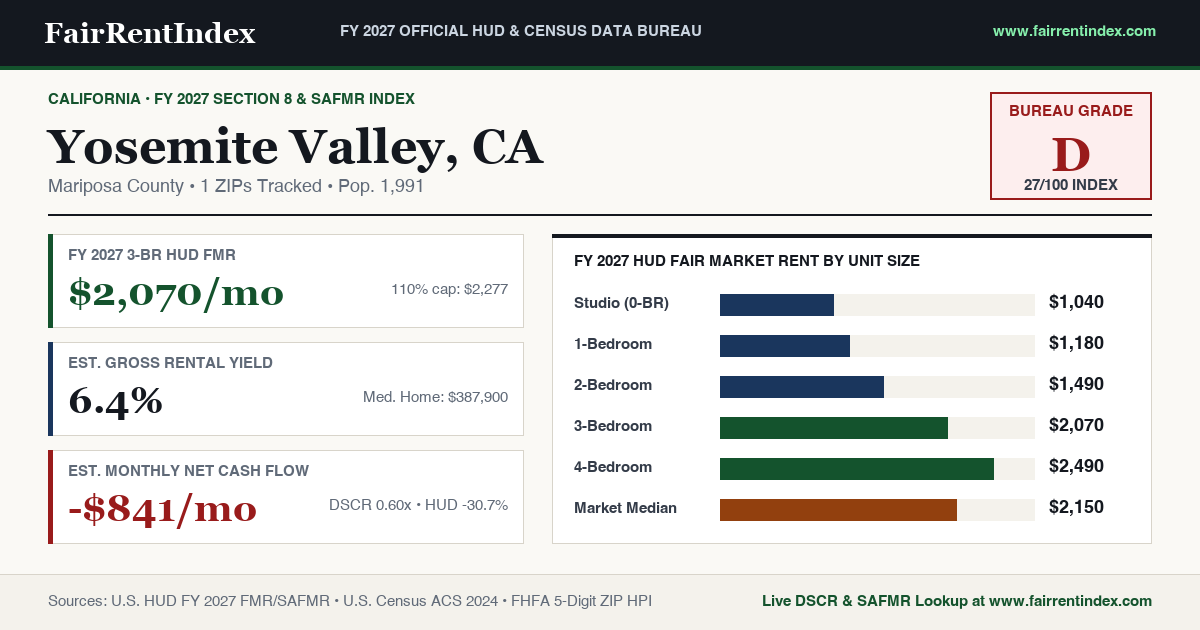
Local rent benchmarks in Yosemite Valley, CA have surged +40.5% over the past five years, outstripping historical national inflation norms. Existing Section 8 landlords should audit current Housing Assistance Payment (HAP) contracts against the FY 2027 schedule ($2,070/mo for a 3-bedroom) and file timely annual rent-increase requests before lease renewal deadlines.
FY 2027 HUD Fair Market Rent Benchmark & Relative Positioning
For Fiscal Year 2027 (effective October 1, 2026), the U.S. Department of Housing and Urban Development establishes a 2-bedroom Fair Market Rent of $1,490/month and a 3-bedroom Fair Market Rent of $2,070/month in Yosemite Valley, CA. On a 3-bedroom basis, this positions Yosemite Valley, CA -40.1% compared to the California population-weighted average ($3,457/mo) and -8.7% relative to the U.S. national benchmark ($2,268/mo).
Under federal regulation (24 CFR § 982.503), Public Housing Agencies operate within a basic range of 90% to 110% of HUD's published FMR without requiring special federal waivers. In Yosemite Valley, CA, that translates into an authorized 2-bedroom payment standard corridor of $1,341 to $1,639/month and a 3-bedroom corridor of $1,863 to $2,277/month. Where PHAs elect the 110% upper band—or secure a 120% exception standard ($2,484/mo for 3-BR)—well-renovated single-family homes can command strong monthly gross receipts. Remember that HUD's FMR includes both contract rent and tenant-paid utility allowances; if the tenant pays gas, electricity, and water separately, the PHA deducts the local utility allowance schedule from the maximum gross cap.
Landlord Cash-Flow Underwriting, Taxes & Housing Stock Reality
Using verified U.S. Census ACS 5-Year housing and property tax filings, owner-occupied residences in Yosemite Valley, CA carry a median valuation of $387,900 and an effective property tax rate of 0.61% (roughly $2,366/year on a median-priced home). Plugging those local inputs into a conservative 3-bedroom buy-and-hold underwriting model (20% down payment, 7.25% 30-year fixed investor loan, $1,950/yr California benchmark landlord insurance, 8% maintenance, 5% vacancy, and 8% professional management) yields an estimated monthly net cash flow of -$841/month and a Debt Service Coverage Ratio (DSCR) of 0.60x.
U.S. Census housing stock records place the median residential build year in Yosemite Valley, CA at 1994, indicating predominantly post-1978 construction. Newer housing inventory typically reduces pre-1978 lead-based paint remediation risks and improves first-time pass rates under HUD's NSPIRE inspection framework—though inspectors still strictly enforce hard-wired or 10-year sealed smoke detectors, carbon monoxide alarms, egress windows, and operational HVAC thresholds.
With a median owner-occupied home value of $387,900 and a local renter share of 100.0%, Yosemite Valley, CA maintains an established tenant pool. Over the past five years, local rent benchmarks shifted by +40.5%, underscoring the inflation-hedging nature of federally indexed rental housing.
California Landlord-Tenant Laws, Eviction Timelines & Regulatory Risk
Yield numbers on paper only materialize when state statutes protect predictable lease enforcement. In our 50-state statutory index, California earns a Grade D (26/100) landlord-friendliness rating. California operates under statewide rent stabilization statutes, requires a standard 3-day notice (strict just-cause) for nonpayment, caps security deposits at 1 month rent (AB 12), and averages approximately 75 days for uncontested nonpayment possession proceedings. California enforces statewide rent caps (AB 1482: 5% + CPI up to 10%), strict source-of-income protections prohibiting Section 8 refusal, and prolonged local eviction dockets, offset by the nation's highest SAFMR ceilings.
Renter Affordability, Cost Burden & Local Housing Authority Administration
From a household affordability perspective, earning enough to pay the FY 2027 2-bedroom Fair Market Rent of $1,490/month without becoming cost-burdened (spending no more than 30% of gross income on housing) requires an annual household income of approximately $59,600—and $82,800/year for a 3-bedroom unit ($2,070/month). Comparing that threshold against Yosemite Valley, CA's Census median household income of $34,282 illustrates why voucher demand remains structurally resilient: across Mariposa County, 48.5% of renter households currently spend more than 30% of income on rent and utilities, including 28.1% who are severely cost-burdened (50%+ of income).
Housing Choice Vouchers in Yosemite Valley, CA are managed by regional or state-level Public Housing Authorities operating within California. Before finalizing a lease or underwriting a purchase, both tenants and landlords should verify the local PHA's current payment standard percentage (90%–110% of FY 2027 FMR) and local utility allowance schedule.